
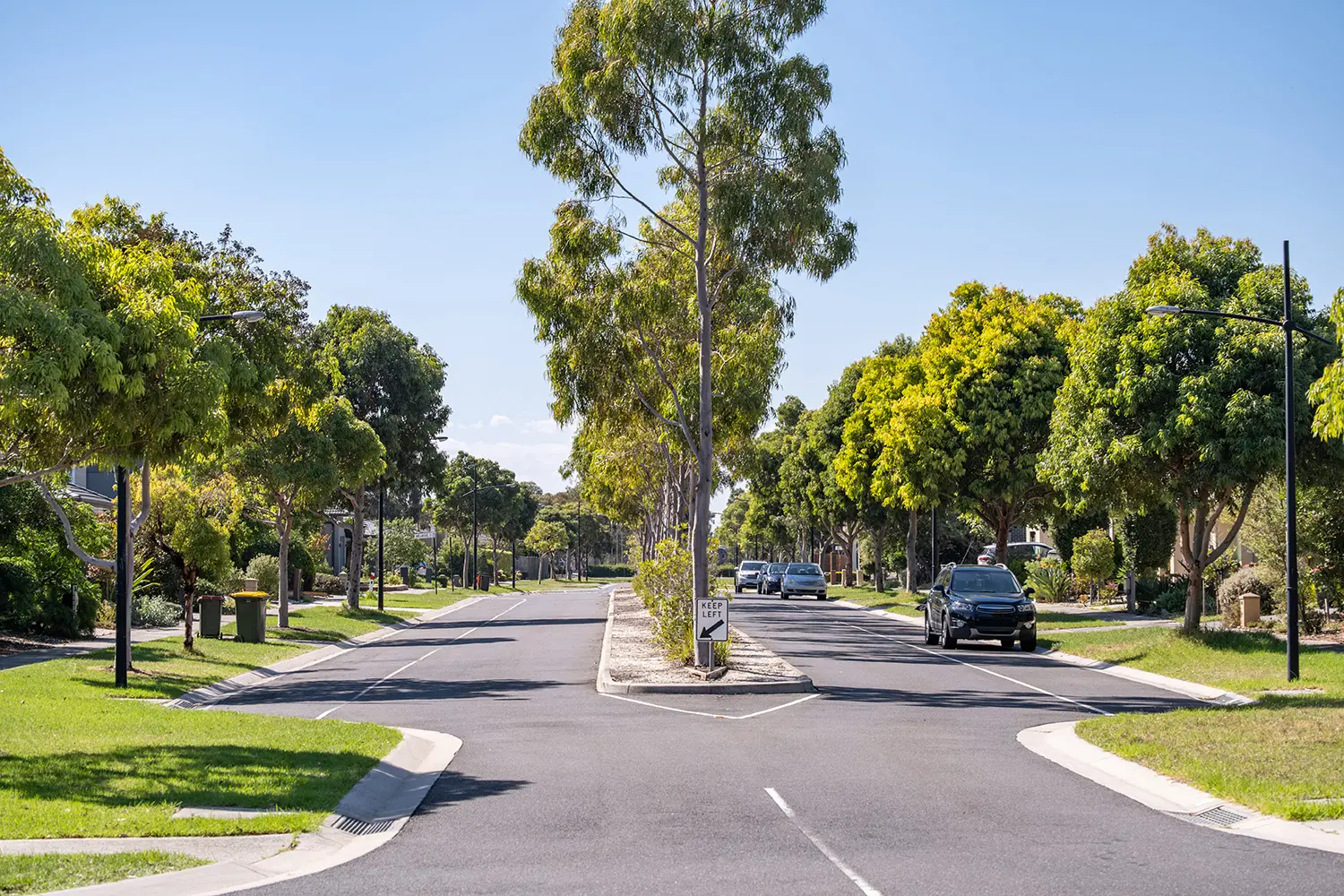
As heat waves become longer and hotter, cities are searching for ways to keep people safe without simply installing more air conditioners and using more electricity. Some of the most promising technology, however, is not technology at all. It has roots, leaves, needs water and has been cooling the planet for hundreds of millions of years.
Trees are increasingly being recognized as an important part of urban infrastructure, alongside streets, sidewalks, drainage systems and public transportation. That may sound strange until you walk down a treeless street on a 100°F afternoon and then turn onto a block covered by mature trees. The difference can be immediate, and scientists are finding that it is not just psychological. Trees can measurably change the temperature around us.
Why Cities Become So Hot
Cities create something called the urban heat island effect. Asphalt, concrete, rooftops and parking lots absorb sunlight during the day and store that energy as heat. After sunset, those surfaces slowly release the heat back into the surrounding air, which is one reason cities can remain uncomfortable long after the sun goes down.
Trees interrupt this cycle in two ways. Their leaves create shade that prevents sunlight from heating pavement and buildings in the first place. Trees also release water through their leaves in a process called evapotranspiration. As that water evaporates, it removes heat from the surrounding environment, somewhat like the way sweat cools our skin.
A 2026 analysis by the World Resources Institute found that trees can improve what researchers call “thermal comfort,” basically how hot the environment actually feels to a person, by roughly 2°C to 8°C, or about 3.6°F to 14.4°F. A global study of 806 cities also found that greater tree canopy was associated with midday land surface temperatures about 1.5°C, or 2.7°F, cooler.
That makes trees much more than decoration.
Medellín Turned Streets Into Green Corridors
One of the best-known examples comes from Medellín, Colombia, where city leaders began turning roads and waterways into connected green corridors filled with trees and other vegetation.
Instead of concentrating greenery inside a few parks, the idea was to bring nature into the places where people actually travel and live. Roads, sidewalks and waterways became part of a connected network of vegetation.
The United Nations Environment Programme reported in 2019 that the project had already lowered temperatures by more than 2°C in treated areas. More recent UNEP reporting says some areas have experienced reductions of up to 4°C while also benefiting from cleaner air and greater biodiversity.
Medellín offers an important lesson because the solution was not simply “plant a lot of trees.” The city used vegetation as part of its physical design, creating corridors that provide shade where people actually need it.
Phoenix Is Beginning to Treat Shade Like Infrastructure
Few American cities understand the danger of heat better than Phoenix, Arizona. The city now describes shade as both “critical infrastructure” and a community resource.
Its Shade Phoenix Plan focuses on increasing tree and constructed shade around places where people spend time outdoors, including sidewalks, parks and routes to public transportation. Phoenix reports that tree canopy varies dramatically across the city, from about 2 percent to 30 percent depending on the census tract.
That difference matters during extreme heat. The city gives an example of conditions where the air temperature in direct sun may be 110°F and a surface can reach 130°F. Under shade, that same type of surface might be around 110°F. The air itself has not suddenly become cool, but the amount of heat hitting a person’s body can fall dramatically.
Phoenix is now working to plant thousands of additional trees, with programs specifically aimed at neighborhoods with little existing canopy.
Paris Is Turning Schoolyards Into Cooling Centers
Paris is approaching the problem from another direction. The city launched its OASIS schoolyard program to replace hard, paved school grounds with trees, vegetation, permeable surfaces and shaded areas.
The long-term goal is to transform hundreds of schoolyards into small neighborhood “cool islands.”
That is especially interesting because a schoolyard normally has one primary purpose. By redesigning it around nature, the same piece of land can become a playground, absorb rainwater, provide habitat and offer relief during extreme heat.
This is the kind of climate adaptation that can quietly become part of everyday life rather than requiring an enormous new piece of infrastructure.
The Newest Research Suggests Trees Are Already Doing More Than We Realize
In May 2026, researchers published one of the broadest examinations yet of urban trees and temperature. The study analyzed 8,919 large urban areas around the world and estimated that today’s urban tree canopy offsets roughly 41 to 49 percent of the air-temperature urban heat island effect that would exist without those trees.
The researchers also found an uncomfortable inequality. Tree cover and its cooling benefits are often greater in wealthier and more suburban areas, while densely populated and lower-income neighborhoods frequently receive less protection.
That pattern is also visible in the United States. Research cited in the study found that lower-income neighborhoods in many American cities averaged about 15 percent less tree cover and land surface temperatures about 1.5°C higher than wealthier neighborhoods.
Where cities plant trees therefore matters almost as much as how many they plant.
A Good Solution Does More Than Solve One Problem
Trees will not stop climate change, and cities cannot plant their way out of rising global temperatures. They also require planning, water, maintenance and enough soil for roots to survive. The right species must be selected for the local climate, particularly in drought-prone places where planting thirsty trees can create another environmental problem.
But urban trees have an unusual advantage over many climate solutions because they solve several problems at once.
They cool streets and buildings, reduce demand for air conditioning, absorb stormwater, remove some air pollution, store carbon and provide habitat for birds and insects. Shaded sidewalks can also make walking and public transportation more comfortable, while greener parks and streets create places where people actually want to spend time.
Perhaps most importantly, this is something cities already know how to do.
Modern cities spent much of the last century removing nature to make room for roads, parking lots and buildings. As temperatures rise, some cities are discovering that part of the solution is simply putting nature back.
The city of the future may need advanced electrical grids, cleaner transportation and better buildings, but it may also need something considerably older.
A lot more trees.
Sources and references
- Nature Communications, 2026.
“Trees halve urban heat island effect globally but unequal benefits only modestly mitigate climate-change warming.” https://www.nature.com/articles/s41467-026-71825-x - World Resources Institute, 2026.
“Urban Trees: An Underused Tool for Keeping People Cool.” https://www.wri.org/insights/urban-trees-cooling-potential - United Nations Environment Programme.
“Medellín shows how nature-based solutions can keep people and planet cool.” https://www.unep.org/news-and-stories/story/medellin-shows-how-nature-based-solutions-can-keep-people-and-planet-cool - United Nations Environment Programme.
“To counter climate change, Colombian cities weave nature back into their urban fabric.” https://www.unep.org/news-and-stories/story/counter-climate-change-colombian-cities-weave-nature-back-their-urban-fabric - U.S. Environmental Protection Agency.
“Using Trees and Vegetation to Reduce Heat Islands.” https://www.epa.gov/heatislands/using-trees-and-vegetation-reduce-heat-islands - Nature Communications, 2021.
“The role of urban trees in reducing land surface temperatures in European cities.” https://www.nature.com/articles/s41467-021-26768-w - City of Phoenix.
“Phoenix’s Urban Forest / Shade Phoenix Plan.” https://www.phoenix.gov/administration/departments/parks/about-us/phoenixs-urban-forest.html - Nature, npj Urban Sustainability, 2025.
“Schoolyards greening for connecting people and nature: an example of nature-based solutions?” https://www.nature.com/articles/s42949-025-00252-6 - University of Florida IFAS, 2025.
“Trees help reduce temperatures in cities: how can we get more of them?” https://blogs.ifas.ufl.edu/ffgs/2025/09/23/trees-help-reduce-temperatures-in-cities-how-can-we-get-more-of-them/ - U.S. Geological Survey.
“Trees in Cities Are Beyond Shady.” https://www.usgs.gov/news/national-news-release/trees-cities-are-beyond-shady
08/16/2026 – This article has been written by the FalseSolutions.Org team
Share this